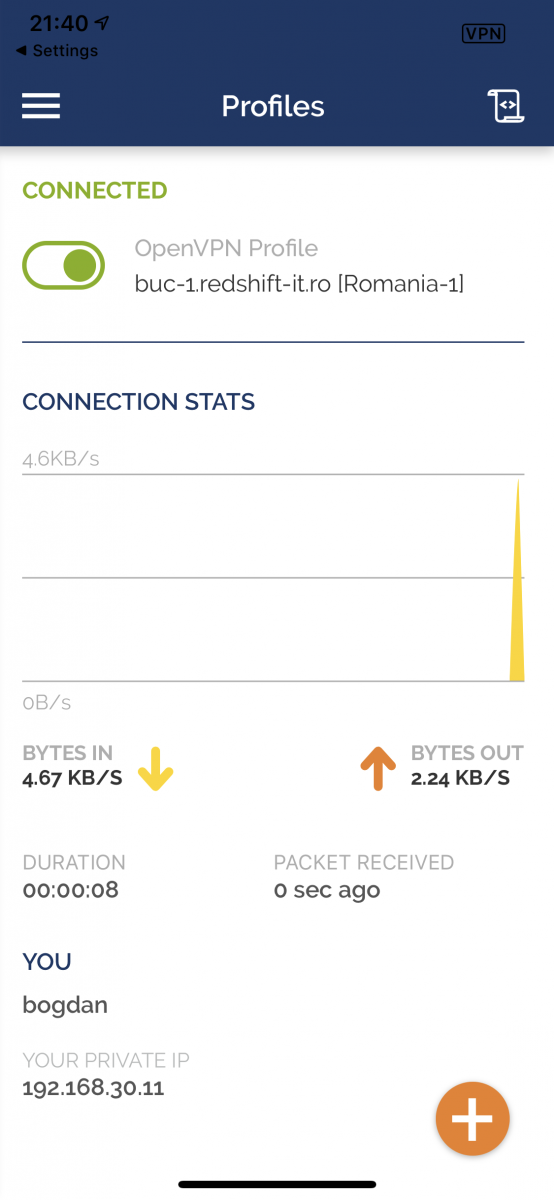

OpenVPN
- Servers
buc-1.rotunneling.netbuc-2.rotunneling.net- Ports
- UDP 1194 / TCP 443
- Authentication
- RoTunneling username and password
The profiles include Romania 1 and Romania 2, over UDP and TCP, on ports 443, 53, 1194 and 8888.

The desktop client uses UT-VPN, our native protocol, built for high speed and low latency.
If one road is blocked, the app takes the next one. On its own. In seconds.
Every connection starts exactly like a browser's, on port 443, like any HTTPS site. To the network, you are just someone browsing the web.
Top speed on any ordinary network, at home, at the office or on mobile.
Encrypted tunnel over TCP with up to 32 parallel connections, on 25 ports tried in order (443 first, like ordinary HTTPS traffic, then 80, 8080, mail ports, DNS-over-TLS and others). When the network allows UDP, data also flows over a fast UDP channel (UDP acceleration), for more speed and lower latency.
When TCP is throttled or filtered, the connection moves to UDP, even from behind a router.
Reliable tunnel over UDP, for networks where TCP is slow or blocked. It works directly, on the servers' fixed UDP ports, or through NAT traversal (NAT-T) when your network does not allow direct UDP connections: the app and the server open a UDP path to each other through NAT.
For hotspots and networks that let little more than name lookups through.
Traffic is carried inside DNS queries, for networks that only let DNS through (such as some hotspots and captive portals).
For networks that block almost everything but still allow ping.
Traffic is carried inside ICMP packets, for networks that block TCP and UDP but allow ping.
When our addresses are blocked, the connection goes around the block through a large data center, as HTTPS traffic.
The connection goes through a cloud-hosted relay on port 443, looking like HTTPS traffic; useful when our server addresses are blocked directly. The network only sees a connection to a large cloud infrastructure. Used automatically when nothing else works; it cannot be chosen manually.
For the strictest networks: the whole connection looks like an ordinary website.
A secure WebSocket (WSS) tunnel delivered through a CDN: the traffic itself, not only the handshake, looks like ordinary web browsing. The last option of automatic mode; it cannot be chosen manually. While it is used, the kill switch turns on automatically.
You press Connect. The app picks the road. How we get through networks that block VPNs
The RoTunneling VPN app tries the modes above by itself and keeps the one that works best on your network. Whatever the mode, the encrypted connection starts with a TLS handshake identical to a modern browser's, so to the network it looks like ordinary web browsing. TCP, UDP, DNS and ICMP can also be chosen manually in Settings > Performance > Transports; Cloud Relay and WSS CDN are used only in automatic mode, as last options.
All modes use the same encryption and the same account; if a route drops, the app moves to the next one automatically. TCP, Cloud Relay and WSS CDN work through an HTTP proxy; UDP, DNS and ICMP do not go through a proxy.
Without the RoTunneling app: OpenVPN (UDP or TCP 443, with our profiles), SSTP (built into Windows, TCP 443) and L2TP/IPsec (iPhone, Mac, routers), with NAT-T on UDP 4500 for connections behind routers.
Version 6.1.1 (build 57). Supported Windows versions: Windows 10 and Windows 11 (64-bit). The installer replaces RoTunneling VPN 5 if it is installed.
The desktop client finds the best path through your network on its own. You do not have to set ports or protocols manually.
Tests the ports and protocols your network accepts (TCP, UDP, DNS, ICMP, Cloud Relay, WSS CDN) and picks the one that works.
If an endpoint does not answer or the connection drops, it tries the next server and port automatically, without disconnecting you.
Adjusts MTU, buffers and encryption parameters to the network and device for high speed and low latency.
Supports authenticated HTTP proxies for networks that do not allow direct internet access.
You can also use a standard client with the settings below. Every method uses the same RoTunneling account.
buc-1.rotunneling.netbuc-2.rotunneling.netThe profiles include Romania 1 and Romania 2, over UDP and TCP, on ports 443, 53, 1194 and 8888.
buc-1.rotunneling.netbuc-2.rotunneling.netUseful when the network blocks OpenVPN or L2TP: the tunnel uses TCP 443, like HTTPS traffic.
OpenVPN, SSTP and L2TP/IPsec, on any device that supports them. They all use the same RoTunneling account.
buc-1.rotunneling.netbuc-2.rotunneling.netWindows, Linux, macOS, iOS, Android and routers. The profiles include Romania 1 and Romania 2, over UDP and TCP.
buc-1.rotunneling.netbuc-2.rotunneling.netNative on Windows; on Linux and routers with an SSTP client; on macOS, iOS and Android only with an app that supports SSTP.
buc-1.rotunneling.netbuc-2.rotunneling.netvpnNative on Windows, macOS, iOS, Android and most routers. On Apple devices, use the signed profile.

Romanian VPN. Servers in Romania, gets past network blocks, support in Romanian and English.
Support: [email protected]



© 2010-2026 RedShift IT SRL. All rights reserved.