

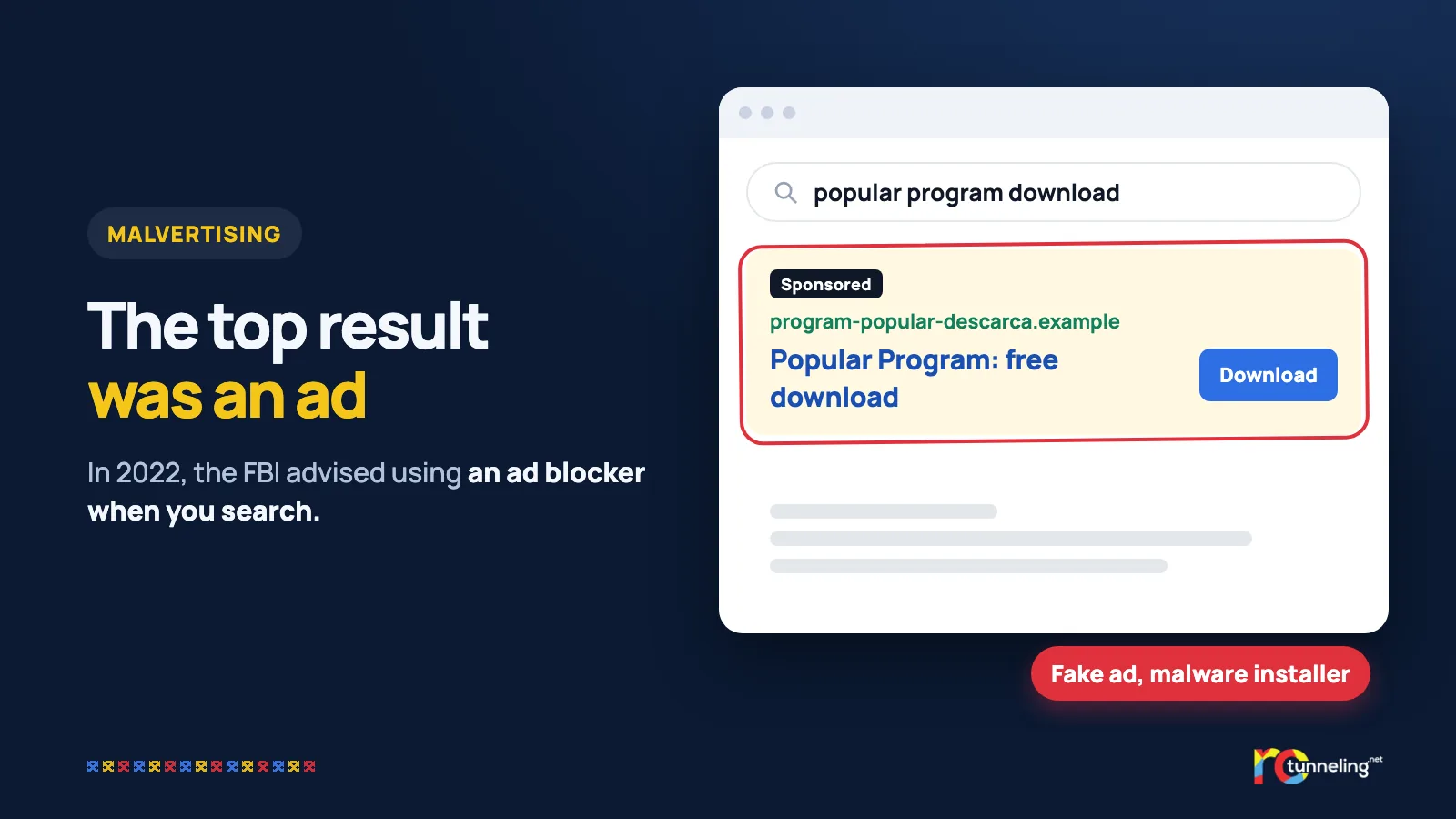
You search for a popular free program to install on your laptop. The top result looks exactly like the official site: the same logo, the same big download button. Except the top result was an ad paid for by someone else, and the file you downloaded had the program's name but contained malware.
What the FBI said
On 21 December 2022, IC3, the FBI's Internet Crime Complaint Center, published the warning "Cyber Criminals Impersonating Brands Using Search Engine Advertisement Services to Defraud Users". In short, the FBI wrote that:
- criminals buy search engine ads for domains that look like those of real businesses;
- the ads appear at the very top of the results, with very little to tell them apart from a normal result;
- the sites they lead to copy the official page, host ransomware and steal login details and financial information;
- some imitate cryptocurrency platforms and ask for login details, so the criminals can then empty the account.
Among the FBI's recommendations for individuals: check the address before you click an ad, type a business's address straight into the browser's address bar instead of searching for it, and use an ad blocking extension when you search the internet.
How the trap works, step by step
- Criminals register a domain almost identical to that of a popular program, for example "program-popular-descarca.example".
- They buy an ad under the program's name, which shows up above the real results.
- The site copies the official page and offers an installer with the right name.
- The installer puts malware on your computer, which can steal passwords and financial details or lock your files for ransom.
What malvertising is
Malvertising means ads used to spread malware. Fake search ads are just one form. There are also ad networks that slip harmful code onto otherwise legitimate sites, pop-ups that scare you with fake messages, and redirects that move you to another page without you clicking anything.
What the protection stops and what it doesn't
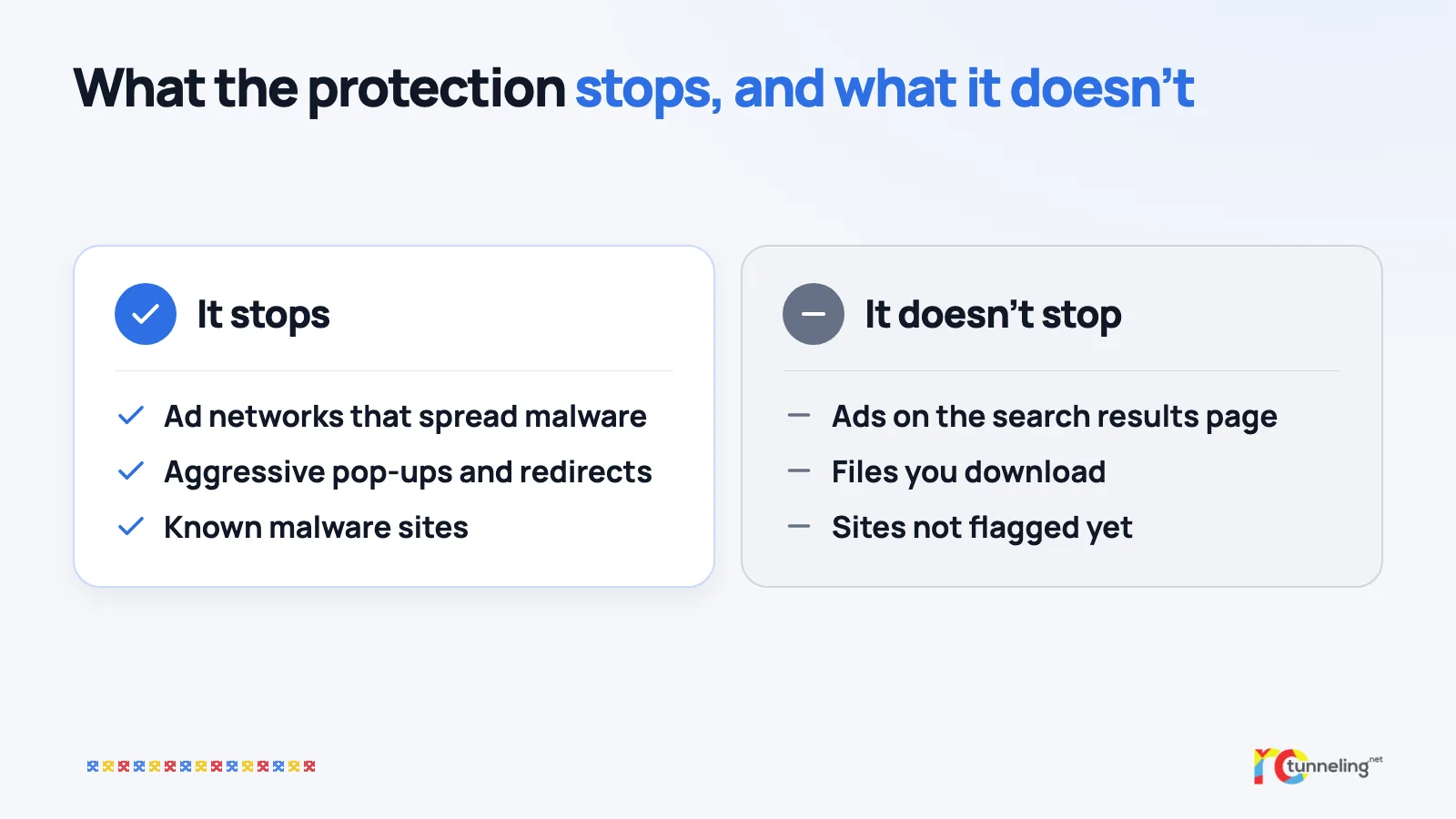
RoTunneling Protect – Malware and Phishing Protection, in the RoTunneling app or through its DoH address, checks every site name before a connection starts. Protect stops:
- ad networks that spread malware;
- aggressive pop-ups and redirects;
- some intrusive ad networks and tracking servers;
- sites known to spread viruses, trojans and ransomware;
- command servers, from which a malicious program already installed gets its orders.
What it doesn't do:
- It doesn't hide ads on the search results page. Those come from the search engine itself. It can, however, stop the fake site the ad leads to, if that site has already been flagged as dangerous.
- It doesn't block every ad. Many ordinary ads stay, because the lists are chosen so that sites and apps keep working normally. If you want to follow the FBI's advice to the letter, add an ad blocking extension to your browser as well.
- It doesn't scan the files you download. That is your antivirus's job.
It reduces the risk. It does not replace your attention or your antivirus.
What protects you
- Download programs only from the official site, typed into the address bar yourself, or from your system's app store.
- Skip results marked "Sponsored" when you look for a program, a bank or a payment platform.
- Read the address before you download. An extra letter, or a word like "download" stuck to the program's name, is a bad sign.
- Don't act on pop-ups that say your phone or computer is "infected". Close the page.
- If you have already installed something suspicious, disconnect the device from the internet, run your antivirus and change your important passwords from another device. In Romania, report it to DNSC on 1911.
RoTunneling in short
RoTunneling VPN encrypts the connection between your device and our servers in Romania on any Wi-Fi, and Protect is on by default in the RoTunneling app. If you only want the protection, without the VPN, you can get it for free through the RoTunneling Protect DoH address, with no account. The guide is at rotunneling.net.
Sources
- FBI IC3, "Cyber Criminals Impersonating Brands Using Search Engine Advertisement Services to Defraud Users", alert I-122122-PSA, 21 December 2022: https://www.ic3.gov/PSA/2022/PSA221221
- RoTunneling, what RoTunneling Protect blocks: https://rotunneling.net/rotunneling-protect-free/?utm_source=blog&utm_medium=article&utm_campaign=malvertising