

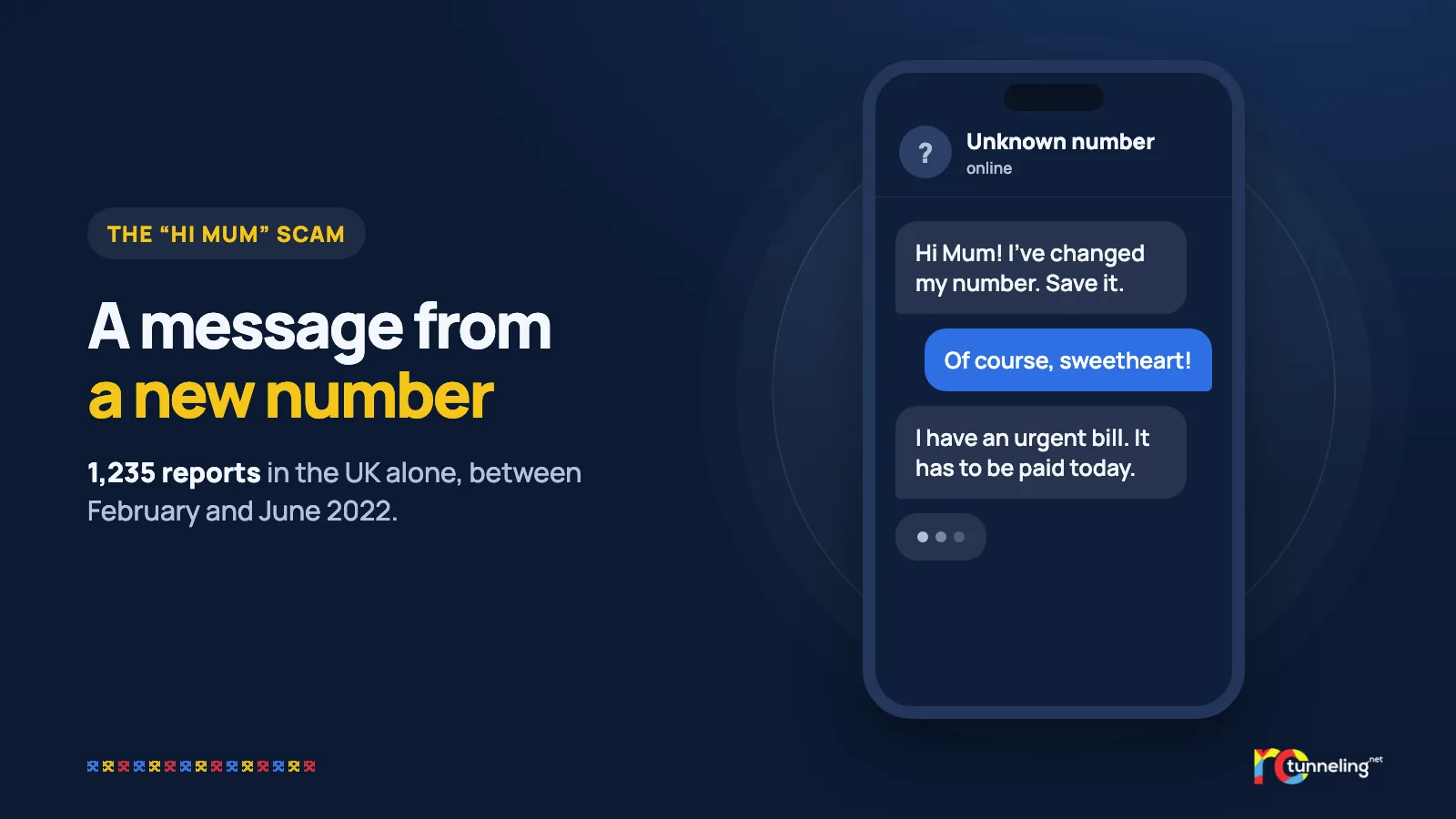
"Hi Mum! My phone broke, this is my new number. Save it." For a parent whose child lives in another country, the message doesn't sound strange at all. A few warm lines follow, then the request. There's an urgent bill to pay today, into an account the child "can't get into from the new phone". They can't call either, because "the microphone isn't working".
What happened
The scam first spread in the UK and Australia under the name "Hi Mum".
- In the UK, the national fraud reporting centre (Action Fraud) received 1,235 reports between 3 February and 21 June 2022. Losses passed £1.5 million.
- In Australia, the consumer watchdog (ACCC) counted more than 1,150 victims and A$2.6 million in losses in the first seven months of 2022 alone. Most of the cases came in June and July.
In Romania, the police warned about the same scheme in 2025, with messages such as "Hi, Dad! I've changed my number, this is my new contact". In one case, a 40-year-old man sent 1,700 lei.
How it works, step by step
- You get a message from an unknown number in a messaging app saying "I've changed my number."
- A short, warm conversation follows to make everything seem normal.
- An urgent request appears for a bill, the rent or a fee. The money has to be sent "today", usually to someone else's account.
- There is always a reason why your "child" can't talk on the phone.
- Once the money is gone, the messages vanish and the number stops answering.
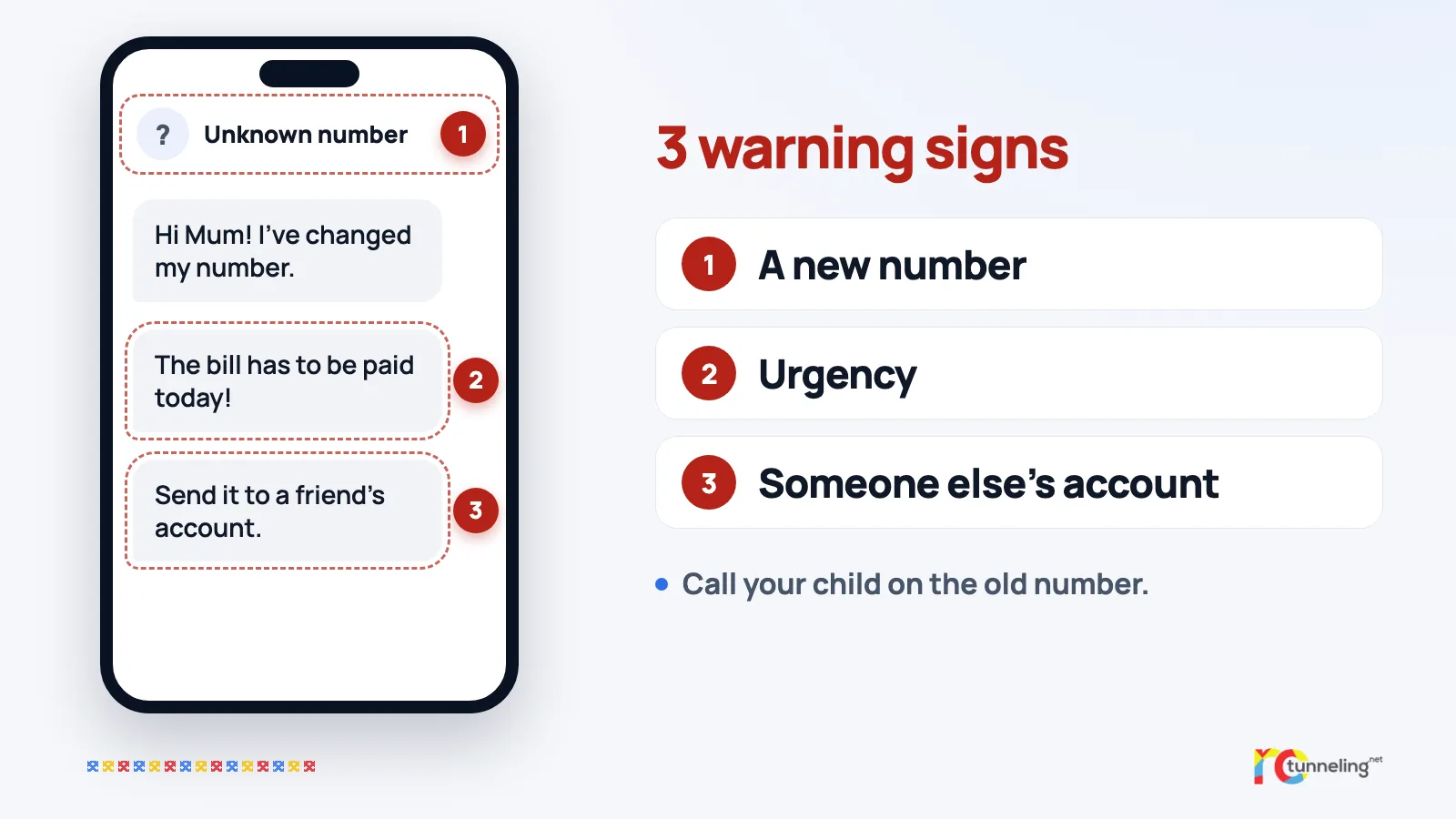
The scammers don't need to know anything about you. They send the same message to thousands of numbers and wait for a single parent to reply.
What protects you
- Call your child on the old number, the one you already have. If they answer, you know everything you need.
- Agree on a code word in the family that only you know. Anyone who doesn't know it gets no money.
- Never send money to a new account based only on a message, however urgent it sounds.
- Never give anyone the SMS code sent by your messaging app. With it, scammers can take over your account and then trick the people in your contacts.
- Turn on two-step verification in the messaging app, from your account settings.
- If you've already sent money, call your bank straight away and report it to the police (112 in Romania).
If your parents are at home and you live abroad, the most useful thing you can do is tell them about this scam before the message reaches them.
Where a VPN helps and where it doesn't
To be direct, a VPN does not protect you from this scam. The scammers make no attempt on your connection. They work on your trust instead. The only real protection is the habit of checking, with a call to the old number and a family code word.
RoTunneling in short
RoTunneling VPN does a different job. It encrypts the connection between your device and our servers on any Wi-Fi, and our apps for Windows, macOS, Linux and Android also connect on restrictive networks that block VPNs. Your traffic leaves through a fast EU exit in Romania, our DNS protection stops malware, phishing and scam sites before they load and blocks some trackers, and we keep no browsing logs. We have been running since 2010, and if you need Romanian sites from abroad, you can also get a Romanian IP. If you're getting your parents ready for the internet, our social media pages also have a guide to 7 things to set on your parents' phone. More at rotunneling.net.
Sources
- Cifas, "Fraud Focus", 25 July 2022 (Action Fraud figures): https://www.cifas.org.uk/newsroom/fraudfocus25-07-22
- ACCC, media release, 23 August 2022: https://www.accc.gov.au/media-release/accc-warning-of-suspicious-messages-as-hi-mum-scams-spike
- Știripesurse, 8 October 2025 (in Romanian): https://www.stiripesurse.ro/frauda-whatsapp-numarul-nou-romani-pacaleala_3818740